Social media automation has quietly moved from a niche operational aid to a mainstream expectation in marketing teams. Scheduling posts, flagging comments, triggering reports, and even generating draft content are now routine parts of many workflows. And yet, despite its widespread adoption, automation remains one of the most misunderstood aspects of modern social media practice.
The problem is not that automation exists. The problem is that it is often framed incorrectly—either as a shortcut to scale without effort or as a dangerous replacement for human judgment. Both views miss the reality of how automation actually works in day-to-day marketing environments.
This article is not about tools, hacks, or growth tricks. It is about clearing up common misconceptions that distort decision-making, lead to poor implementations, and ultimately create more work rather than less. The goal is to help marketers think more clearly about where automation fits, where it does not, and why context matters more than capability.
Why This Topic Matters Now
Automation is no longer optional in most social media teams—not because it is trendy, but because the operating environment has changed.
Content volume has increased. Platform expectations have risen. Response windows are shorter. Reporting cycles are tighter. At the same time, teams have not grown proportionally. In many organizations, the same or fewer people are expected to manage more channels, more formats, and more stakeholders.
Against this backdrop, automation is often introduced under pressure. A backlog is forming. Engagement is slipping. Leadership wants consistency. Someone suggests “automating more of it,” and the discussion jumps straight to tools rather than outcomes.
That jump is where most misconceptions begin.
Automation, when misunderstood, becomes a blunt instrument applied to nuanced problems. When understood correctly, it becomes a support system for judgment, not a substitute for it.
Real-World Pressure on Marketers
Most misconceptions about automation are not theoretical. They come from very real constraints.
Marketers are expected to:
Maintain always-on presence across platforms
Respond quickly without sounding robotic
Publish consistently without sacrificing quality
Prove impact without drowning in manual reporting
Under these conditions, automation can look like relief. Or like risk. Often both.
The pressure is not just operational. There is reputational risk as well. A poorly timed automated post, an inappropriate response, or an off-brand message can undo weeks of careful work. That tension—between efficiency and control—is what makes automation such a charged topic.
Understanding what automation actually does, and what it cannot do, is the first step toward resolving that tension.
Setting Expectations Early
There are no shortcuts here.
Automation does not fix unclear strategy. It does not compensate for weak positioning. It does not understand nuance unless that nuance has already been encoded into decisions and rules. And it does not eliminate the need for oversight.
What it does do—when implemented thoughtfully—is reduce repetitive cognitive load, enforce consistency where consistency is appropriate, and create space for humans to focus on higher-value judgment calls.
If that framing feels less exciting than vendor demos or headline promises, that is intentional. Sustainable automation is rarely exciting. It is practical.
What This Actually Means in Practice
Clarifying Definitions
One reason automation is misunderstood is that the term is used too broadly.
Social media automation can refer to:
Scheduling and publishing content
Routing messages or comments
Applying predefined responses or tags
Triggering reports or alerts
Assisting with content drafting or analysis
These are not the same thing. They operate at different levels of decision-making and carry different risks.
Confusion arises when people talk about “automating social media” as if it were a single action. In reality, teams automate specific steps within a workflow—not the entire workflow itself.
Commonly Confused Concepts
Automation is often conflated with:
AI-generated content
Autonomous decision-making
Hands-off management
Most automation in social media is deterministic, not intelligent. It follows rules. It executes instructions. Even when machine learning is involved, it operates within constraints defined by humans.
Assuming automation implies autonomy is one of the most persistent misconceptions—and one of the most damaging.
How This Shows Up in Real Workflows
In practice, automation usually sits between planning and execution.
A human decides:
What to say
Why it matters
When it should or should not go out
Automation ensures:
It goes out at the intended time
It appears consistently across channels
It is tracked and logged properly
When those boundaries are respected, automation feels invisible. When they are not, it becomes obvious very quickly.
How It Works (Conceptually, Not Technically)
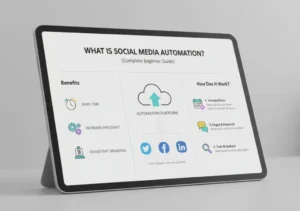
At a conceptual level, social media automation follows a simple flow:
Inputs → Decisions → Outcomes
Inputs are content, timing rules, triggers, or thresholds.
Decisions are pre-defined choices based on those inputs.
Outcomes are posts published, messages flagged, reports generated, or actions taken.
The critical point is this: most decisions in automated systems are made before the system runs, not while it runs.
The intelligence lives upstream—in strategy, governance, and rule-setting. The system simply enforces what has already been decided.
When automation fails, it is rarely because the system “did the wrong thing.” It is because the wrong assumptions were baked into it.
Platform, Channel, and Use-Case Differences
Automation behaves very differently depending on context.
High-Velocity Platforms
On platforms where volume and speed dominate, automation tends to be more useful for:
Scheduling
Filtering
Prioritization
The cost of minor errors is lower, but the need for responsiveness is higher. Here, automation supports scale, not nuance.
Community-Driven Channels
In spaces where conversation quality and trust matter more than reach, automation must be constrained carefully. Over-automation is quickly noticed and often resented.
In these contexts, automation is better used to surface signals, not to generate responses.
Campaign vs Always-On Work
Automation shines in repeatable, predictable scenarios:
Campaign launches
Recurring content formats
Regular reporting cycles
It struggles in reactive or ambiguous situations:
Crisis response
Cultural moments
Sensitive feedback
Understanding these differences prevents a common mistake: applying the same automation logic everywhere.
What Works Well (With Reasoning)
Automation adds real value when it is applied to known patterns.
If a task:
Happens frequently
Follows clear rules
Has low variance in acceptable outcomes
…it is a strong candidate for automation.
Examples include:
Publishing pre-approved content
Flagging messages based on keywords or sentiment
Generating standardized performance summaries
Why does this work?
Because automation excels at consistency. It does not get tired, distracted, or inconsistent. When the goal is reliable execution rather than creative judgment, systems outperform humans.
Limitations, Risks, and Trade-Offs
Where teams get into trouble is assuming those strengths apply universally.
Common Failure Modes
Automating before clarifying strategy
Treating automation as a cost-cutting measure rather than a quality control mechanism
Over-optimizing for efficiency at the expense of relevance
Another frequent issue is feedback blindness. Automated systems do exactly what they are told, even when conditions change. Without regular review, small mismatches compound into visible problems.
Why Blind Adoption Causes Issues
Automation scales both good decisions and bad ones.
If tone guidelines are unclear, automation amplifies inconsistency.
If approval processes are weak, automation accelerates mistakes.
If metrics are poorly chosen, automation optimizes the wrong outcomes.
This is why automation maturity is less about tools and more about governance.
Human Judgment vs Automation and Systems
A useful mental model is this:
Humans decide what matters.
Systems enforce how it happens.
What Should Remain Human-Led
Strategic direction
Brand voice interpretation
Contextual judgment
Ethical and reputational decisions
These require situational awareness that systems do not possess.
Where Automation Supports Strategy
Automation supports humans by:
Reducing manual repetition
Highlighting anomalies
Maintaining consistency
Freeing attention for higher-order thinking
Seen this way, automation is not about replacement. It is about leverage.
Where This Is Heading
The future of social media automation is not about full autonomy. It is about tighter integration between human intent and system execution.
Trends that are already visible:
More emphasis on guardrails and approvals
Better visibility into why systems act
Increased focus on assistive, not generative, automation
What is unlikely to change is the need for judgment. Platforms evolve, formats change, and audience expectations shift—but the responsibility for deciding what is appropriate remains human.
Final Takeaways
Most misconceptions about social media automation stem from treating it as a solution rather than a system.
Automation:
Does not remove responsibility
Does not replace strategy
Does not eliminate risk
What it does—when applied with care—is make disciplined execution possible at scale.
The teams that succeed with automation are not the ones using the most advanced tools. They are the ones with the clearest thinking about what should be automated, why, and under what constraints.
In that sense, automation is less a technological challenge and more a leadership one.