Social media automation is not a new idea. Marketers have been scheduling posts and pulling reports for over a decade. What has changed is the scale, speed, and pressure surrounding social platforms—and the growing temptation to let systems do more than they should.
For many teams today, social media sits at an uncomfortable intersection. Leadership wants consistency and measurable outcomes. Audiences expect relevance, responsiveness, and a human voice. Platforms change rules frequently. And marketers are expected to “be everywhere” without expanding time or headcount.
That tension is why social media automation keeps coming up—not as a growth hack, but as an operational question: what should be systematized, and what still requires human judgment?
This guide takes a practical look at social media automation without hype. No promises of effortless growth. No claims that AI will “run your brand for you.” Just a clear explanation of what automation actually means in practice, where it adds value, and where it creates risk if misunderstood.
What This Actually Means in Practice
At its core, social media automation refers to using systems to handle repeatable, predictable tasks in the social media workflow.
That distinction matters.
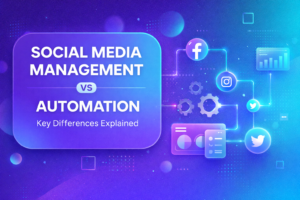
Automation is not the same thing as social media management. Management includes strategy, creative direction, audience understanding, brand voice, partnerships, and decision-making. Automation supports parts of that work—it does not replace it.
In practice, automation usually shows up in five broad areas:
- Planning and scheduling content
- Repurposing and distributing content across platforms
- Supporting engagement and moderation
- Monitoring conversations and signals
- Collecting and summarizing performance data
Each of these solves a different problem. They also introduce different trade-offs.
A common mistake is treating “automation” as a single capability. In reality, it’s a collection of systems layered onto human-led processes. When those layers are added thoughtfully, they reduce friction. When they’re added indiscriminately, they amplify mistakes.
How Social Media Automation Works (Conceptually)
You don’t need to understand tools or APIs to understand automation. What matters is the flow.
Most automation systems follow the same basic pattern:
Inputs → Rules or decisions → Outputs
- Inputs might be content, keywords, messages, performance data, or user actions.
- Rules or decisions determine what happens next—sometimes fixed, sometimes assisted by AI.
- Outputs are actions: a post goes live, a message is tagged, a report is generated, or a notification is sent.
The effectiveness of automation depends far less on the software than on the quality of the inputs and the judgment behind the rules.
If the content is weak, automation will distribute weak content more efficiently.
If the rules are poorly defined, automation will repeat the same mistake at scale.
That’s why experienced teams treat automation as an operational layer—not a creative one.
Scheduling and Publishing: The Foundation Layer
The most common—and usually the safest—form of social media automation is scheduling.
This simply means preparing posts in advance and allowing them to publish automatically at predefined times. It sounds basic, but it solves a real operational problem: consistency.
From a workflow perspective, scheduling enables:
- Batching content creation instead of daily posting pressure
- Platform-specific formatting without real-time effort
- Fewer missed posts during busy weeks or time off
Where teams get into trouble is assuming scheduling equals strategy. It doesn’t.
Scheduling answers when content goes out, not what should go out or why. Without a clear content framework, scheduling just creates noise on a calendar.
Used properly, it frees mental space. Used carelessly, it creates the illusion of progress.
Content Repurposing and Distribution
As content volumes increase, repurposing becomes less about creativity and more about logistics.
Most marketing teams already repurpose informally: a blog becomes a LinkedIn post, a webinar becomes a clip, a podcast becomes a quote graphic. Automation formalizes that behavior.
In practice, this means systems that:
- Adapt one core idea into multiple platform-ready formats
- Distribute variations automatically, often with human review
- Maintain consistency across channels without manual duplication
The value here is not “more content.” It’s reduced friction between idea and execution.
That said, repurposing only works when the original idea is strong and when platform context is respected. What works as a long-form insight on LinkedIn may feel out of place on TikTok or X.
Automation can move content faster. It cannot decide whether the content belongs on a platform.
Engagement Support (Not Engagement Replacement)
Engagement is where automation becomes controversial—and for good reason.
There is a clear difference between supporting engagement and simulating engagement.
Supportive automation helps teams manage volume and response time:
- Tagging messages based on intent or keywords
- Routing inquiries to the right person or inbox
- Drafting replies that a human approves or edits
This kind of automation respects the fact that audiences want timely responses, but also authentic ones.
What tends to fail is automation that attempts to replace interaction—generic auto-replies, unsolicited DMs, or scripted comment responses at scale. These systems often optimize for activity rather than trust.
The line is simple: if automation removes judgment from the interaction, it usually creates long-term brand damage.
Social Listening and Monitoring
Listening automation focuses on awareness rather than output.
Instead of asking “what should we post?”, listening asks:
- Where is our brand being mentioned?
- What topics are gaining momentum?
- What are competitors or peers being discussed for?
This type of automation turns ambient noise into structured signals. Alerts, summaries, and dashboards help teams notice things they would otherwise miss.
The real value isn’t reacting to everything—it’s recognizing patterns early. Trends, issues, and opportunities rarely announce themselves clearly. Automation helps surface them, but humans still decide what matters.
Analytics and Reporting
Reporting is one of the least controversial uses of automation—and one of the most underutilized.
Automated analytics typically consolidate:
- Reach, engagement, clicks, and growth
- Performance by platform, format, or theme
- Time-based trends rather than isolated metrics
The benefit here isn’t more data. It’s less manual interpretation.
When reports are generated consistently, teams spend less time assembling numbers and more time asking better questions: What’s compounding? What’s stalling? What’s misaligned with business goals?
Automation doesn’t make insights smarter—but it makes reflection more likely.
Lead Capture and Downstream Integration
This is where social media stops being “awareness only” and starts connecting to revenue systems.
In practice, automation here might involve:
- Passing form submissions into a CRM
- Triggering follow-up emails after social actions
- Tracking campaign attribution through links
The important shift is accountability. Once social activity is connected to downstream systems, performance conversations change. Social is no longer just “engagement”—it’s part of a larger funnel.
This also increases risk. Poorly designed automation can overwhelm sales teams, misattribute results, or create false confidence. Integration requires governance, not just enthusiasm.
Platform and Context Differences
Automation does not behave equally across platforms.
Some platforms reward consistency and predictable formats. Others prioritize immediacy, originality, or cultural relevance. Some tolerate scheduled content well. Others penalize repetition or obvious systemization.
The key mental model is this: automation should adapt to platform behavior, not force uniformity.
What feels professional on LinkedIn can feel robotic on Instagram. What works in B2B may backfire in creator-driven environments. Automation needs contextual boundaries.
Where Automation Adds Real Value
When implemented thoughtfully, social media automation excels in a few clear areas:
- Reducing operational fatigue
- Improving consistency without burnout
- Making performance review routine instead of reactive
- Allowing teams to focus on judgment-heavy work
It works best when there is already clarity—about audience, voice, and goals. Automation amplifies existing discipline. It does not create it.
Limitations, Risks, and Trade-Offs
Most automation failures are not technical. They are conceptual.
Common issues include:
- Over-automation before strategy is defined
- Mistaking activity for effectiveness
- Publishing tone-deaf content during sensitive moments
- Losing feedback loops because “the system handles it”
The biggest risk is false efficiency. Systems make it easy to do more, faster—but they don’t make it easier to do better.
Automation should reduce friction, not reduce responsibility.
Human Judgment vs. Systems
Certain decisions should remain human-led:
- Voice, tone, and positioning
- Cultural and contextual sensitivity
- Priority setting and trade-offs
- Long-term brand direction
Automation is best treated as decision support. It surfaces options, patterns, and reminders. Humans decide what matters.
When that balance is lost, brands sound efficient—and forgettable.
Where This Is Heading
Despite new tools and increasing AI capability, the fundamentals are stable.
Audiences still respond to relevance, clarity, and trust. Platforms still reward value over volume. Strategy still matters more than execution speed.
What’s changing is expectation. Teams are expected to operate with systems, not spreadsheets. Reporting is assumed. Consistency is table stakes.
Automation isn’t becoming optional—but discernment remains essential.
Final Takeaways
Social media automation is neither a shortcut nor a threat. It’s an operational layer that reflects how modern marketing actually works.
Used responsibly, it protects focus, reduces waste, and supports better decisions. Used blindly, it scales the wrong behaviors faster.
The question isn’t whether to automate. It’s what to automate, when, and under whose judgment.
That answer will always depend on context—and that’s exactly why automation should serve strategy, not replace it.