Marketing teams have always relied on systems. Even before the current wave of tools and AI-driven platforms, workflows were built around repeatable processes: campaign calendars, briefing documents, approval chains, reporting cycles. What has changed is not the existence of systems, but their speed, scale, and visibility.
Automation now sits at the center of many modern marketing conversations. Sometimes it is framed as a productivity unlock. Sometimes as a threat to craft. Often, it is positioned as something marketers must either fully embrace or risk falling behind.
That framing is unhelpful.
Automation is neither a shortcut nor a strategy. It is an operational capability that can support good marketing—or amplify bad marketing—depending on how it is applied. Understanding where automation fits, and where it does not, is now a core competency for senior marketers.
This article explores that fit in practical terms.
Not how to automate everything. Not which tools to buy. But how automation actually functions inside a modern marketing workflow when it is used responsibly, deliberately, and in service of clear objectives.
Why This Topic Matters Now
The pressure on marketing teams has changed shape.
Budgets are more scrutinized. Channels are more fragmented. Attribution is less certain. Audiences are more selective, more skeptical, and more distracted than ever. At the same time, expectations have increased. Stakeholders want faster turnaround, more personalization, better reporting, and clearer impact.
This creates a structural tension.
Marketing work has expanded, but time and headcount often have not. The natural response is to look for leverage. Automation promises leverage: doing more with the same resources, or at least avoiding collapse under operational load.
However, the cost of getting this wrong is higher than it used to be.
Poorly implemented automation does not just waste time. It erodes trust with audiences, degrades internal confidence, and can quietly undermine strategy while appearing productive on the surface.
That is why this topic matters now. Not because automation is new, but because its consequences—good and bad—are more visible and more compounding.
Setting Expectations Early
There are no shortcuts here.
Automation does not fix unclear strategy. It does not create insight where none exists. It does not remove the need for judgment. In many cases, it increases the importance of judgment, because mistakes scale faster.
Used well, automation reduces friction. Used poorly, it creates noise at scale.
The goal of this article is to set realistic expectations and provide a mental model for where automation belongs inside a modern marketing workflow—and where it should be constrained.
What This Actually Means in Practice
Clarifying the Definition
When marketers talk about automation, they often mean different things.
Sometimes they are referring to task automation: scheduling posts, sending emails, generating reports. Sometimes they mean decision automation: rules-based actions triggered by behavior. Increasingly, they also mean content assistance: systems that help draft, adapt, or repurpose messaging.
These are not interchangeable.
Automation, in a practical marketing sense, is the use of systems to execute predefined actions or support decisions based on inputs and rules defined by humans.
It is not autonomy. It is not strategy. And it is not creativity in the human sense.
Separating Commonly Confused Concepts
Three concepts are frequently conflated:
Automation: Executing known tasks or flows repeatedly and consistently.
Optimization: Improving performance based on feedback and measurement.
Intelligence: Understanding why something works and deciding what to do next.
Automation can support optimization. Optimization can surface insights. But none of these replace intelligence or judgment.
Problems arise when automation is treated as a substitute for thinking, rather than as an extension of execution.
How Automation Shows Up in Real Workflows
In mature marketing organizations, automation tends to cluster around specific workflow stages:
Intake and routing (briefs, approvals, handoffs)
Execution at scale (publishing, deployment, delivery)
Monitoring and reporting (dashboards, alerts, summaries)
Maintenance tasks (list hygiene, tagging, archiving)
Notice what is missing from that list.
Automation rarely belongs at the point where positioning is defined, narratives are shaped, or trade-offs are decided. It supports those decisions; it does not make them.
How It Works Conceptually (Not Technically)
At a high level, marketing automation follows a simple model:
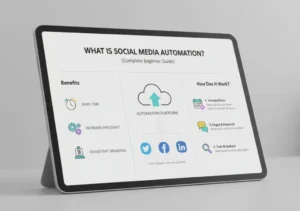
Inputs → Rules or Models → Actions → Feedback
Inputs might include audience behavior, campaign schedules, content assets, or performance data. Rules or models define how the system responds. Actions are the outputs—messages sent, content published, reports generated. Feedback closes the loop by informing future decisions.
The sophistication of the system does not change the structure of the loop. What changes is how much discretion the system has within it.
Well-designed automation keeps discretion narrow and explicit. Poorly designed automation allows systems to act without clear boundaries, often because those boundaries were never defined.
The most effective marketers spend less time configuring actions and more time clarifying inputs and constraints.
Platform, Channel, and Use-Case Differences
Automation does not behave the same way across contexts.
Owned Channels vs Rented Platforms
In owned channels like email or CRM systems, automation tends to be more predictable. Inputs are clearer. Feedback loops are tighter. The brand controls the environment.
On rented platforms—social networks, ad platforms, marketplaces—automation operates inside opaque systems. Algorithms change. Signals are imperfect. What worked last quarter may degrade without warning.
This does not mean automation should be avoided on rented platforms, but it does mean guardrails matter more.
High-Volume vs High-Stakes Contexts
Automation excels where volume is high and individual risk is low: routine updates, standard notifications, recurring reports.
As stakes increase—brand positioning, sensitive communications, crisis response—the tolerance for automated decision-making drops sharply.
The mistake many teams make is assuming that because something is repeatable, it is safe to automate. Repeatability and risk are not the same thing.
Speed vs Sensitivity Trade-Offs
Automation optimizes for speed and consistency. Human processes optimize for nuance and judgment.
Every workflow sits somewhere on that spectrum. The role of a senior marketer is to decide where speed matters more, and where sensitivity does.
What Works Well (With Reasoning)
Automation adds real value in specific, well-defined areas.
Reducing Cognitive Load
By handling routine execution and maintenance tasks, automation frees human attention for higher-order work. This is not about doing more campaigns; it is about preserving decision quality.
When marketers are not buried in manual steps, they make better strategic calls.
Enforcing Consistency
Automation is good at enforcing rules humans forget to follow. Naming conventions, tagging, compliance checks, and timing constraints all benefit from system enforcement.
Consistency is not glamorous, but it is foundational.
Scaling Proven Patterns
Once a workflow is validated—through testing, learning, and iteration—automation helps scale it without reintroducing friction. The key is that the pattern must already be proven.
Automating an untested idea simply accelerates failure.
Improving Observability
Automated reporting and monitoring do not just save time. They change how teams see their work. When feedback is timely and accessible, decisions improve.
This is often an underappreciated benefit of automation.
Limitations, Risks, and Trade-Offs
Where Teams Get This Wrong
The most common failure mode is premature automation.
Teams automate before they understand their audience, before they have stable messaging, or before they have agreed on success metrics. The result is activity without learning.
Another common issue is automation without ownership. Systems run, outputs are generated, but no one feels accountable for outcomes because “the system did it.”
Automation does not remove responsibility. It concentrates it.
The Risk of False Productivity
Automated workflows can create the illusion of progress. Messages go out. Dashboards update. Reports fill inboxes.
But movement is not the same as direction.
Senior marketers learn to distinguish between operational efficiency and strategic effectiveness. Automation improves the former. It does nothing for the latter unless guided.
Compounding Errors
When humans make mistakes, they are usually localized. When automated systems make mistakes, they scale.
This is why governance matters. Clear review points, escalation paths, and override mechanisms are not bureaucracy; they are risk controls.
Human Judgment vs Automation
What Must Remain Human-Led
Certain responsibilities should remain firmly human:
Defining positioning and narrative
Interpreting ambiguous signals
Making trade-offs under uncertainty
Responding to cultural or contextual shifts
Deciding when not to act
These require context, empathy, and experience. No system can fully replicate that.
Where Automation Supports Strategy
Automation supports strategy by making execution reliable, feedback visible, and experimentation manageable.
It allows humans to spend more time deciding what matters and less time pushing buttons.
The healthiest teams treat automation as infrastructure, not intelligence.
Where This Is Heading
Despite rapid tool evolution, some fundamentals are unlikely to change.
Marketing will remain a discipline of judgment under uncertainty. Audiences will continue to resist manipulation and reward relevance. Platforms will continue to change incentives in ways marketers do not control.
What will evolve is how comfortably teams operate alongside systems.
The future belongs to marketers who can design workflows, define constraints, and oversee automated execution without surrendering accountability.
Not those who automate everything—but those who automate deliberately.
Final Takeaways
Automation is not a destination. It is a design choice inside a broader marketing system.
Used well, it reduces friction, improves consistency, and supports better decision-making. Used carelessly, it scales noise and obscures responsibility.
The question is not whether to automate, but where, how, and under what constraints.
Senior marketers earn their value not by configuring systems, but by deciding what those systems are allowed to do—and when they must defer to human judgment.
That responsibility does not disappear with automation. It becomes more important.